Biocracked
←

#mouse study

2 articles
Approach: macro science. Palette: bold color field (violet).

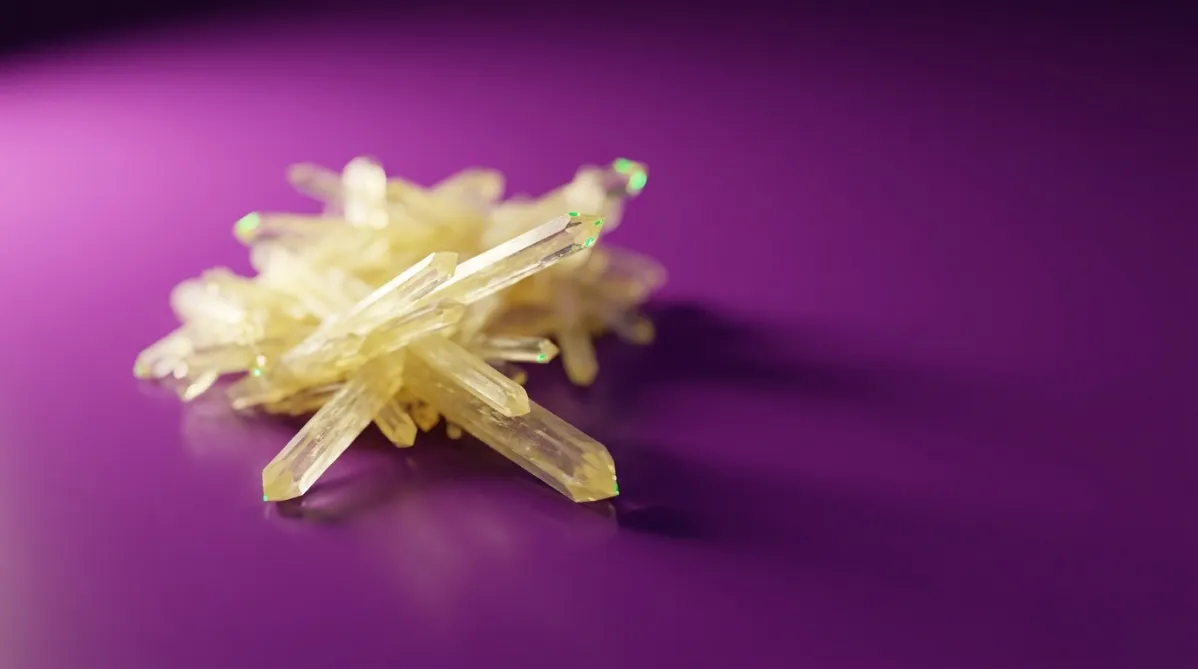
Extreme close-up of fisetin crystals, a small cluster of pale yellow needle-like flavonoid crystals with translucent, faceted edges, resting on a smooth glossy deep violet surface. The camera sits low at a shallow three-quarter angle with a very shallow depth of field, so the front crystals are razor sharp and the rest dissolves into soft magenta-violet blur. Lighting is a single crisp, slightly warm studio key from upper left that makes the crystal edges glow and throws long soft shadows across the violet. A few tiny electric green (#00e676) specks of reflected light catch on the crystal tips. The mood is precise, curious and quietly promising, like a sample under inspection, with plenty of clear violet space on the right side of the frame.
longevity

Fisetin‑Senolytikum verlängert das Leben von Mäusen – menschlicher Nachweis fehlt

BY HELIX WARD ·

Fisetin, ein pflanzliches Flavonoid, erwies sich in einer häufig zitierten EBioMedicine‑Studie von 2018 als das wirksamste Senolytikum von zehn getesteten Verbindungen. Bei alten Mäusen, die erst spät im Leben behandelt wurden, senkte es die Marker für Zellseneszenz, verbesserte altersbedingte Pathologien und erhöhte sowohl die mittlere als auch die maximale Lebensspanne. Der Haken: Es handelt sich um Maus‑ und Laborbefunde, nicht um abgeschlossene Humanstudien. Dieser Beitrag erklärt, was die Forscher*innen gefunden haben, welche Dosierung tatsächlich gemeint ist und für wen die Ergebnisse relevant sein könnten, sobald klinische Studien am Menschen voranschreiten.

A wide landscape editorial photograph of a minimalist laboratory-meets-wellness still life on a pale, warm-gray stone countertop, softly lit by diffused morning window light from the left. In the center foreground, a small amber glass supplement jar with a plain matte white label sits beside a scattering of fine white powder and a few loose white capsules on a ceramic dish. Next to it rests a clean, open notebook with faint hand-drawn line graphs, two diverging curves rising gently, one slightly higher than the other, drawn in muted sage-green and charcoal ink. A slim brass pen lies across the page.

In the soft-focus midground, a delicate glass beaker filled with clear liquid catches a thin streak of light, casting a gentle caustic shimmer across the stone. A sprig of dried eucalyptus and a small sliver of citrus peel add organic texture. Behind them, an out-of-focus wall of pale oat-colored tiles and a floating wooden shelf holds a few blurred ceramic vessels and a small potted fern.

The color palette is calm and editorial: warm creams, sage green, soft amber, muted terracotta accents, and touches of charcoal. Shallow depth of field with a crisp focus on the jar and notebook, creamy bokeh in the background. Subtle film-like grain, natural shadows, and generous negative space on the right third of the frame, suitable for headline overlay. The mood is thoughtful, measured, and trustworthy, like a contemporary science and wellness journal cover: modern, tactile, quietly optimistic, and grounded rather than hyped.
longevity

Calcium‑Alpha‑Ketoglutarat verlängert die Lebensdauer weiblicher Mäuse um bis zu 16,6 % – Was das für Menschen bedeutet (und nicht bedeutet)

BY DR. SYNAPSE ·

Eine 2020‑Studie in *Cell Metabolism* zeigte, dass eine mit 2 % Calcium‑Alpha‑Ketoglutarat (CaAKG) angereicherte Nahrung die mediane Lebenszeit von weiblichen Mäusen um bis zu 16,6 % verlängerte und deren Gebrechlichkeit verringerte. In einer zweiten Versuchszusammenstellung war der Effekt etwas geringer (10,5 %), und bei den Männchen waren die Überlebensgewinne statistisch nicht signifikant. Die Autoren führen den Nutzen auf eine reduzierte systemische Entzündung und einen Anstieg von IL‑10 zurück. Die Studie wurde ausschließlich an Mäusen durchgeführt und liefert keinen Nachweis, dass CaAKG das menschliche Leben verlängert. Im Folgenden wird erklärt, was die Daten tatsächlich zeigen, wie sie sich von typischen Marketingversprechen unterscheiden und warum CaAKG eher auf einer Forschung‑Watchlist als in einem bewiesenen Protokoll zu finden ist.

This page is available in